L-theanine has an unusual appeal: it may help you relax while still feeling alert and focused.
That is why people use it in very different situations. Some take it during the workday to take the edge off mental tension. Others pair it with coffee for smoother focus. And some use it in the evening when their mind feels too switched on to settle down.
Found naturally in tea, L-theanine has been studied for attention, short-term stress, sleep quality, cortisol response, and cognitive performance. Its strongest practical role is calm focus without heavy sedation.
What is L-theanine?
L-theanine is an amino acid found naturally in Camellia sinensis, the plant used to make green, black, white, and oolong tea.
It contributes partly to tea's savory, umami taste.
You can get L-theanine from tea, but supplements provide a much more predictable amount. A cup of tea usually contains less L-theanine than the doses used in human studies, which commonly range from around 50 to 400 mg.
That difference is important when comparing the effect of drinking tea with taking a measured L-theanine supplement.
What are the main benefits of L-theanine?
L-theanine is best known for calm focus, but human research also suggests potential benefits for stress and sleep.
A 2026 review of 31 randomized trials involving 1,168 participants found benefits across several cognitive and affective outcomes, including improved reaction time after a single 200 mg dose.
A 2025 review of sleep research also found improvements in several self-reported sleep outcomes.
The broader evidence on L-theanine benefits follows the same overall pattern: calm focus has the strongest practical case, with useful research around stress and sleep as well.

L-Theanine for calm focus and attention
Calm focus is where L-theanine stands out.
Instead of making you feel stimulated, it appears to support a more relaxed mental state while leaving you able to stay engaged with what you're doing.
A 2026 review of randomized trials found that a single 200 mg dose improved reaction time on an attention task when taken 30 to 60 minutes before testing.
An earlier study in adults aged 50 to 69 also found faster responses on an attention task and improvements in short-term memory performance.
That combination is especially appealing when tension itself is getting in the way of concentration.
Rather than creating more stimulation, L-theanine may help make focus feel steadier and less mentally noisy.
L-Theanine for stress and relaxation
L-theanine has also been studied for how people respond to stressful situations.
A 4-week study using 200 mg per day found improvements in stress-related measures, sleep, and cognitive performance.
Shorter laboratory studies also suggest that L-theanine can support a calmer response when people are exposed to acute stress.
That fits with another interesting finding: L-theanine appears to affect brain activity associated with relaxed alertness.
In one human brain-wave study, 50 mg of L-theanine increased alpha-wave activity.
Alpha waves are commonly seen when you are relaxed but still awake and mentally present.
This may help explain why L-theanine can feel different from more sedating calming ingredients.
The current evidence on L-theanine and anxiety looks more closely at what researchers have found when stress and anxious feelings overlap.
L-Theanine for sleep
L-theanine may also help with sleep, particularly when the problem is difficulty winding down rather than simply feeling physically tired.
A 2025 review of 19 articles involving 897 participants found improvements in several sleep-related outcomes, including perceived sleep quality and daytime functioning.
A separate 2026 review of standalone L-theanine also found favorable results across both measured and self-reported sleep outcomes.
The interesting part is that L-theanine does not appear to work like a heavy sedative.
Instead, it may help create the calmer mental state needed to transition into sleep, which can be particularly useful when your body is tired but your mind is still racing.
The research on L-theanine for sleep looks more closely at timing, sleep quality, and the study doses researchers have used.
Does L-theanine make you sleepy?
Usually not in the same way as a traditional sleep aid.
People in attention studies are still able to perform cognitive tasks after taking L-theanine, which supports the idea that relaxation does not automatically mean sedation.
Some people may still feel sleepy or more relaxed than expected, especially depending on the dose and what else they are taking.
If L-theanine makes you unusually drowsy, dizzy, or impaired, stop using it and review the full product with a clinician or pharmacist.
How L-theanine affects cortisol
L-theanine has some interesting human research around the stress response and cortisol.
In a 2021 controlled trial, a single 200 mg dose produced a larger drop in salivary cortisol than placebo one hour after participants completed a short laboratory stress test.
That suggests L-theanine may help the body settle after a stressful event.
A 2024 controlled trial also looked at daily use for 28 days. Morning cortisol fell from baseline in the L-theanine group, although the change was similar to placebo.
So the clearest signal currently comes from short-term stress, rather than proof that L-theanine consistently lowers everyday cortisol over the long term.
The research on L-theanine and cortisol explains that distinction in more detail.
L-Theanine with caffeine
L-theanine and caffeine are often paired because their effects can complement each other.
Caffeine increases alertness and energy. L-theanine may help give that alertness a calmer, steadier feel.
In a study using 97 mg of L-theanine with 40 mg of caffeine, participants performed better on task-switching measures and reported feeling more alert.
A 2025 research review also found small-to-moderate improvements across several attention and cognitive outcomes when researchers examined tea, L-theanine, and L-theanine combined with caffeine.
This pairing can be especially appealing if coffee helps you focus but sometimes leaves you feeling:
- jittery
- restless
- mentally scattered
- overly stimulated
L-theanine will not completely cancel out too much caffeine, though. If you are sensitive to caffeine, the amount you use still matters.
The research on L-theanine and caffeine looks more closely at attention, alertness, task switching, and the popular L-theanine-to-caffeine ratios.
How does L-theanine work?
L-theanine appears to influence brain activity involved in relaxation and attention.
Its effect on alpha-wave activity is one clue. Researchers have also studied how L-theanine interacts with signaling between brain cells, although much of the detailed mechanism work comes from laboratory and animal research.
For everyday use, human research gives the more useful answer:
L-theanine appears to help create a calmer mental state without necessarily reducing alertness.
That matches the findings seen across attention, stress, and sleep studies.
How quickly does L-theanine work?
L-theanine can act relatively quickly.
Human studies often measure effects around 30 to 60 minutes after a dose.
Research looking at absorption also suggests that blood levels rise within roughly the first hour.
That makes L-theanine different from supplements such as ashwagandha, which are generally studied over several weeks.
How quickly you personally notice an effect can depend on:
- dose
- food
- caffeine
- other supplement ingredients
- individual sensitivity
How long do the effects last?
There is no exact duration that applies to everyone.
L-theanine levels in the blood fall relatively quickly, but that does not directly tell us how long its calming or cognitive effects remain noticeable.
If you're testing L-theanine for yourself, keeping the dose and timing consistent can make it easier to understand how long the effect lasts for you.
When is the best time to take L-theanine?
The best time depends on what you want from it.
For calm focus
Morning or early-day use makes sense when you want to stay focused while feeling less tense.
Attention studies often give L-theanine around 30 to 60 minutes before testing.
With coffee
Take it around the same time as caffeine if your goal is smoother alertness and concentration.
For sleep
Evening use may make more sense when you want help winding down before bed.
There is no universal best clock time.
Your caffeine intake, medications, other supplements, and personal response can all change how L-theanine feels.
How much L-theanine do studies use?
There is no single universal L-theanine dose.
Different amounts are used depending on whether researchers are studying attention, stress, sleep, cortisol, or caffeine combinations.
These amounts provide research context, not a universal recommendation.
Your own use should take into account your health history, medications, other supplements, and the reason you are taking L-theanine.
How to choose an L-theanine supplement

For a standalone L-theanine supplement, look for a label that clearly states the amount per serving.
The format itself matters less than knowing what you are actually getting.
For combination products, ask a different question:
Does each ingredient have a clear role?
Caffeine, minerals, calming compounds, and herbal stress-support ingredients can all change what the finished formula is designed to do.
Is L-theanine safe?
L-theanine appears to be well tolerated at commonly studied amounts.
A 2026 review of 31 randomized studies reported no serious adverse events, while a 12-week study also found repeated use was generally well tolerated.
Possible side effects
Reported side effects are usually mild when they occur.
They can include:
- headache
- dizziness
- stomach discomfort
- dry mouth
- fatigue
- sleep changes
Your response may also depend on other supplements or medications taken at the same time.
L-theanine and medications
If you take prescription medication, check how L-theanine fits with the rest of your routine.
Memorial Sloan Kettering Cancer Center recommends caution with sedative medications.
L-theanine may also affect blood pressure.
If you take medication for:
- blood pressure
- sleep
- anxiety
- or another ongoing condition
your doctor or pharmacist can help review the combination.
Pregnancy and breastfeeding
Research on concentrated L-theanine supplements during pregnancy and breastfeeding is limited.
The NIH LactMed record for green tea notes that transfer of L-theanine into breast milk has not been studied.
If you are pregnant, trying to conceive, or breastfeeding, discuss supplemental L-theanine with your clinician.
Where L-theanine fits in Harmonia
L-theanine has a clear role in Harmonia: calm focus without adding another stimulant.
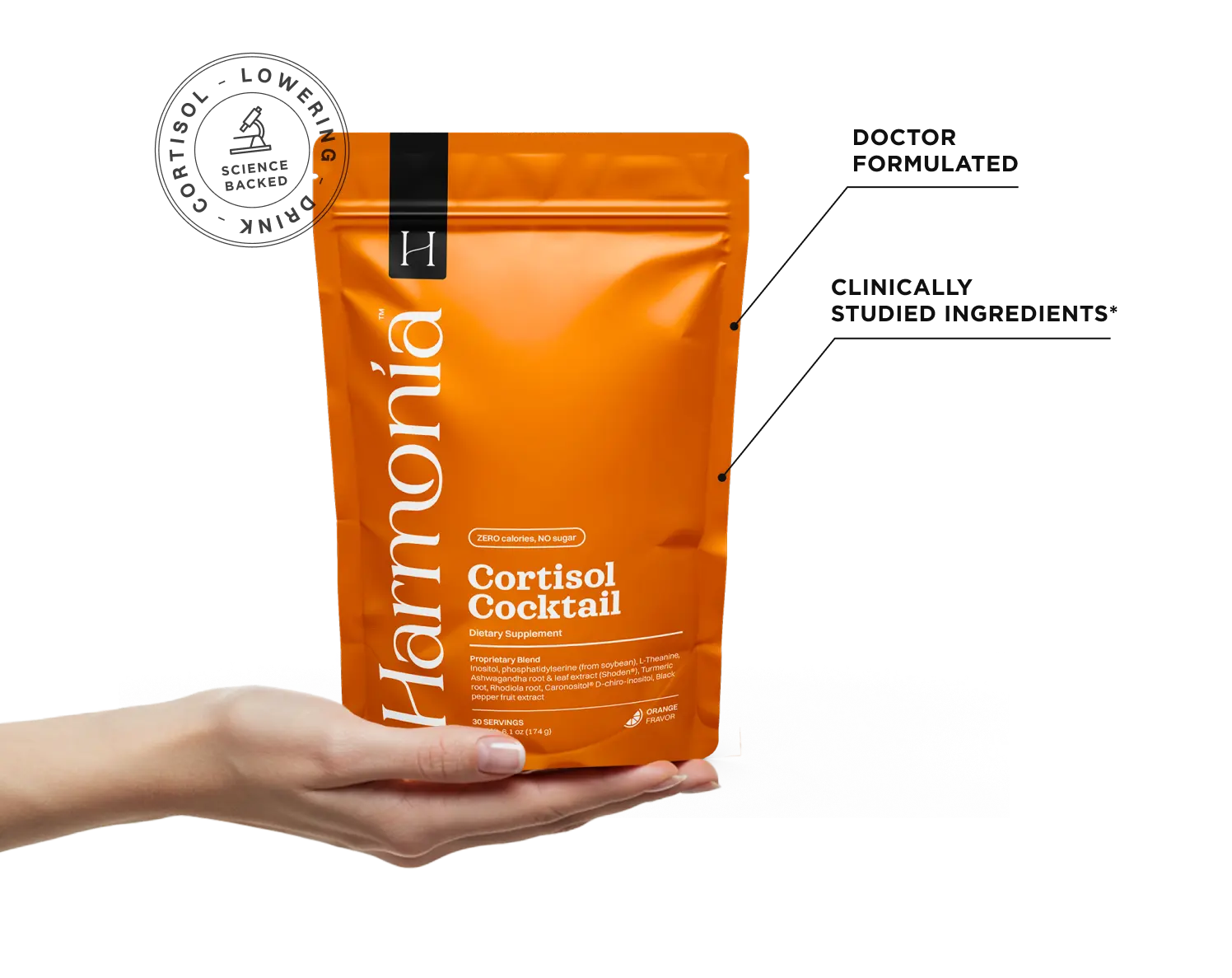
The Harmonia Cortisol Cocktail combines L-theanine with ingredients selected for different parts of the stress response.
KSM-66 ashwagandha provides multi-week stress and cortisol support, Rhodiola rosea is studied for stress-related fatigue, magnesium supports normal nervous-system function, and inositols are involved in insulin and hormone signaling.
L-theanine adds something different. Its role is to support the mental side of stress, especially when tension makes it harder to focus, stay settled, or switch off.
That gives each ingredient a defined place within the formula. The ingredients in the Harmonia formula address different ways ongoing stress can show up, including focus, cortisol response, fatigue, and hormone-related patterns.
%20(1).jpeg)
The bottom line
L-theanine is one of the more interesting supplements for people who want to feel calmer without feeling switched off.
Its strongest practical role is calm focus, with human research also supporting stress response and sleep quality.
It can act relatively quickly, often within 30 to 60 minutes in research settings, and it pairs particularly well with caffeine when the goal is alertness with less mental tension.
L-theanine usually does not cause heavy sedation, which is why it can fit both daytime and evening routines depending on the goal.
In Harmonia, that calm-focus role complements ingredients selected for cortisol, stress-related fatigue, nervous-system support, and hormone signaling.
If stress keeps showing up in your focus, sleep, energy, cravings, or hormone-related symptoms, you can take the Harmonia quiz to see whether the Harmonia Cortisol Cocktail fits what you're experiencing.
Frequently asked questions
What is L-theanine good for?
L-theanine is best known for calm focus and relaxation without heavy sedation. Human studies also suggest benefits for stress response, attention, and sleep quality.
Does L-theanine help with stress?
It may. Human research suggests L-theanine can support a calmer response during stressful situations while allowing you to remain mentally alert.
Does L-theanine help you focus?
Yes, attention studies have found improvements in reaction time and other cognitive measures. Its appeal is that focus may feel calmer rather than more stimulated.
Does L-theanine make you sleepy?
Usually not heavily. L-theanine can feel relaxing, but people in attention studies remain able to perform cognitive tasks after taking it. Some people may still feel drowsier than others.
Can you take L-theanine with coffee?
Yes. L-theanine is commonly paired with caffeine, and research suggests the combination can support alertness, attention, and task switching.
How long does L-theanine take to work?
Human studies often measure effects around 30 to 60 minutes after taking it. The exact timing depends on dose, food, caffeine, and individual response.
When is the best time to take L-theanine?
Morning or early-day use fits calm focus and caffeine pairing. Evening use may be more useful when your goal is relaxation or sleep.
Can you take L-theanine every day?
Regular use has been studied in humans and appears generally well tolerated at commonly studied amounts. If you take prescription medication or several supplements, check with a clinician or pharmacist before regular use.
Does L-theanine lower cortisol?
It may support a healthier cortisol response after short-term stress. Longer-term effects on daily cortisol remain less clear.
Is L-theanine safe?
L-theanine appears generally well tolerated. Side effects are usually mild when they occur. Extra care is appropriate with sedative or blood-pressure medication and during pregnancy or breastfeeding.
References
- Gerolymos C, Saddier E, Boyer L, Fond G. 2026. Cognitive and affective effects of L-Theanine: a systematic review and meta-analysis of 31 randomized trials. Molecular Psychiatry. Link
- Bulman A, D'Cunha NM, Marx W, Turner M, McKune A, Naumovski N. 2025. The effects of L-theanine consumption on sleep outcomes: A systematic review and meta-analysis. Sleep Medicine Reviews. Link
- Cotter J, Caddick CE, Harper JL, Ebajemito JK. 2026. Examining the effect of L-theanine on sleep: a systematic review of dietary supplementation trials. Nutritional Neuroscience. Link
- Williams JL, et al. 2025. Effects of Tea (Camellia sinensis) or its Bioactive Compounds L-Theanine or L-Theanine plus Caffeine on Cognition, Sleep, and Mood in Healthy Participants: A Systematic Review and Meta-Analysis of Randomized Controlled Trials. Nutrition Reviews. Link
- Baba Y, Inagaki S, Nakagawa S, Kaneko T, Kobayashi M, Takihara T. 2021. Effects of L-Theanine on Cognitive Function in Middle-Aged and Older Subjects: A Randomized Placebo-Controlled Study. Journal of Medicinal Food. Link
- Hidese S, Ogawa S, Ota M, et al. 2019. Effects of L-Theanine Administration on Stress-Related Symptoms and Cognitive Functions in Healthy Adults: A Randomized Controlled Trial. Nutrients. Link
- Evans M, McDonald AC, Xiong L, Crowley DC, Guthrie N. 2021. A Randomized, Triple-Blind, Placebo-Controlled, Crossover Study to Investigate the Efficacy of a Single Dose of AlphaWave L-Theanine on Stress in a Healthy Adult Population. Neurology and Therapy. Link
- Moulin M, Crowley DC, Xiong L, Guthrie N, Lewis ED. 2024. Safety and Efficacy of AlphaWave L-Theanine Supplementation for 28 Days in Healthy Adults with Moderate Stress: A Randomized, Double-Blind, Placebo-Controlled Trial. Neurology and Therapy. Link
- Giesbrecht T, Rycroft JA, Rowson MJ, De Bruin EA. 2010. The combination of L-theanine and caffeine improves cognitive performance and increases subjective alertness. Nutritional Neuroscience. Link
- Nobre AC, Rao A, Owen GN. 2008. L-theanine, a natural constituent in tea, and its effect on mental state. Asia Pacific Journal of Clinical Nutrition. Link
- van der Pijl PC, Chen L, Mulder TPJ. 2010. Human disposition of L-theanine in tea or aqueous solution. Journal of Functional Foods. Link
- Memorial Sloan Kettering Cancer Center. L-Theanine. About Herbs. Link
- Drugs and Lactation Database (LactMed). Green Tea. National Institute of Child Health and Human Development. Updated May 15, 2025. Link