Ashwagandha does not appear to cause weight gain in most people. Controlled human studies have not found unwanted weight gain as a consistent effect, and some trials have reported the opposite: modest weight loss, lower BMI, or fewer food cravings.
That does not mean ashwagandha is a weight-loss supplement. Its strongest evidence is for stress and cortisol support. Because stress can affect sleep, cravings, appetite, and eating habits, improving the stress response may indirectly influence weight for some people.
If the number on the scale changed after you started ashwagandha, the supplement may not be the only thing worth looking at. Sleep, stress, appetite, medications, activity, hormones, and fluid changes can all affect weight at the same time.
Does ashwagandha cause weight gain?
Current human research does not show weight gain as a typical ashwagandha effect.
Here is the short version:
So if you gained weight after starting ashwagandha, it is worth looking at the bigger picture rather than assuming the supplement directly caused fat gain.
What do human studies show about ashwagandha and weight?
The most relevant randomized trials point more toward lower weight and fewer cravings than toward weight gain.
That said, these studies are relatively small, and the amount of weight lost varies considerably.
One study found modest weight loss and fewer cravings
A 2017 randomized trial followed 52 adults with chronic stress for 8 weeks.
Participants took either 300 mg of KSM-66 ashwagandha root extract twice daily or a placebo.
By week 8:
- body weight had fallen by 2.32 kg in the ashwagandha group versus 1.13 kg with placebo
- BMI decreased more with ashwagandha
- food-craving and eating-behavior scores also improved
The trial was small and included more men than women, so the exact amount of weight loss should not be treated as a typical result.
What makes the study interesting is the combination of lower weight, lower stress, and fewer cravings. It suggests ashwagandha may be most relevant to weight when chronic stress and eating behavior are connected.
A longer trial found a larger weight change
A 2025 randomized trial followed 100 adults with overweight for 24 weeks.
Participants again took 300 mg of ashwagandha twice daily or a placebo.
Average body weight fell by:
- 8.46 kg with ashwagandha
- 2.41 kg with placebo
Food-craving, stress, and quality-of-life scores also improved.
The result is striking, but it should not be interpreted as “ashwagandha makes you lose 8 kg.” Diet, sleep, and physical activity were not tightly controlled, and the weight change was much larger than in the earlier study.
The more useful takeaway is that some evidence points toward weight loss, not weight gain, particularly when stress and cravings are part of the problem.
What the main studies found
Overall, the existing human research gives little reason to expect ashwagandha to cause weight gain as a typical effect.
Why might your weight still change after starting ashwagandha?
Body weight can change while several other things are changing at the same time.
For example:
- stress may improve or worsen
- your appetite may change
- you may sleep more or less
- your activity level may change
- medications may be added or stopped
- hormones or thyroid function may shift
- fluid retention can temporarily change scale weight
This makes personal stories online difficult to interpret.
Someone may genuinely gain weight after starting ashwagandha, but that does not necessarily mean ashwagandha caused it. A personal experience cannot isolate all the other factors changing at the same time.
Claims that ashwagandha routinely causes weight gain by “slowing metabolism,” “normalizing metabolism,” or causing water retention go beyond what controlled human trials have shown.

Does ashwagandha increase appetite or make you hungry?
Increased hunger has not appeared as a consistent effect in controlled human studies.
If anything, some research points toward fewer cravings.
In the 24-week weight study, participants taking ashwagandha reported lower scores on a food-craving questionnaire that included hunger-related questions.
That does not prove they ate fewer calories. It simply means they reported less craving or hunger-related difficulty.
Does ashwagandha suppress appetite?
Ashwagandha is not an established appetite suppressant.
Some studies have found lower hunger or food-craving scores, but that is different from directly suppressing appetite.
A separate study in 60 college students found that participants taking 700 mg of ashwagandha per day had lower food-craving scores over 30 days than those taking placebo.
The 2017 chronic-stress trial also reported improvements in food cravings and eating behavior.
Together, these findings suggest that ashwagandha's connection to weight may partly involve stress-related eating rather than a direct effect on appetite.
If your appetite drops sharply after starting any supplement, particularly alongside vomiting, abdominal pain, or persistent digestive symptoms, stop taking it and seek medical advice.
Can ashwagandha help with weight loss?
Possibly, especially when chronic stress or food cravings are making weight management harder.
Ashwagandha is not a stimulant or fat burner. It does not appear to work by directly increasing calorie burning.
Instead, its potential value may come from supporting factors that influence weight indirectly, including:
- chronic stress
- sleep
- food cravings
- emotional eating
- consistency with healthy routines
The broader evidence on how chronic stress can affect weight helps explain why improving the stress response may influence eating behavior and weight over time.
The research does not give us a dependable amount of weight loss or a guaranteed timeline. If weight loss is your goal, ashwagandha is better viewed as one possible support alongside nutrition, movement, sleep, and appropriate medical care.

What does cortisol have to do with weight?
Ashwagandha has much stronger research behind stress and cortisol than it does behind weight loss.
A 2024 review of nine randomized trials involving 558 participants found lower perceived stress and blood cortisol with ashwagandha formulations compared with placebo.
Cortisol itself is not bad. Your body needs it for normal energy regulation, waking, and responding to stress.
The problem is that ongoing stress can also disrupt sleep, appetite, cravings, and daily routines. Those changes can make weight management more difficult.
Understanding the normal role of cortisol in the body helps put this in perspective: the goal is not to push cortisol as low as possible, but to support a healthy stress response.
KSM-66, the standardized root extract used in the 2017 weight trial, also has research behind stress and cortisol outcomes. The broader evidence on supplements studied for cortisol support can help put ashwagandha in context alongside other stress-support ingredients.
Does ashwagandha cause weight gain in women?
Current research does not suggest that women are particularly likely to gain weight from ashwagandha.
Women were included in the main weight studies, but those trials were not designed to calculate a separate female-specific effect.
The 2017 study included 14 women, while the longer 2025 trial included both men and women.
For women in their 30s, 40s, and 50s, weight can also change alongside:
- perimenopause or menopause
- thyroid changes
- medication use
- poor sleep
- changes in insulin sensitivity
- stress and activity levels
That makes it especially important not to assume every weight change after starting a supplement was caused by the supplement itself.
If sleep is part of the picture, the research on ashwagandha and sleep quality looks at that outcome separately.
Does ashwagandha cause water retention?
Water retention has not been established as a typical ashwagandha effect in controlled human research.
Temporary bloating can make your stomach feel or look different without representing actual body-fat gain.
New swelling or rapid unexplained weight gain is different. Fluid retention can have many causes unrelated to supplements and may need medical evaluation.
Does ashwagandha speed up metabolism?
There is no good evidence that ashwagandha reliably increases metabolic rate in healthy adults.
One randomized trial in 50 adults with subclinical hypothyroidism found changes in thyroid hormone levels after participants took 600 mg of ashwagandha per day for 8 weeks.
But thyroid hormones and metabolic rate are not the same outcome. The study did not show that participants burned significantly more calories.
Because ashwagandha may affect thyroid hormones, people with thyroid disorders or those taking thyroid medication should discuss regular use with a clinician.
Can muscle gain make your weight go up?
Possibly, if you are strength training.
Ashwagandha has been studied alongside resistance exercise, and some studies suggest it may support gains in muscle size and strength.
In one trial, 57 young men taking 300 mg twice daily during 8 weeks of resistance training gained more muscle size and strength than participants taking placebo.
A later study involving active men and women also reported greater gains in muscle girth during resistance training.
If someone is actively strength training, gaining muscle could make scale weight stay the same or rise even while body composition improves.
That is very different from ashwagandha directly causing unwanted fat gain.

Ashwagandha side effects and safety
Ashwagandha is generally well tolerated by many adults when used short term.
NCCIH safety guidance lists possible short-term side effects such as:
- drowsiness
- stomach upset
- diarrhea
- vomiting
Weight gain is not listed among the better-established effects.
NCCIH advises avoiding ashwagandha during pregnancy and breastfeeding. Extra caution is also recommended around surgery, autoimmune conditions, thyroid disorders, and medications that affect blood pressure, blood sugar, seizures, thyroid function, or the immune system.
The NIH Office of Dietary Supplements fact sheet provides more detail on different preparations, interactions, and current safety evidence.
If you develop jaundice, dark urine, severe abdominal symptoms, or another concerning reaction after starting ashwagandha, stop using it and seek medical advice.
Where ashwagandha fits in Harmonia
_11zon.jpeg)
Ashwagandha's role in Harmonia is not to make you gain or lose weight. It is there to support the stress response.
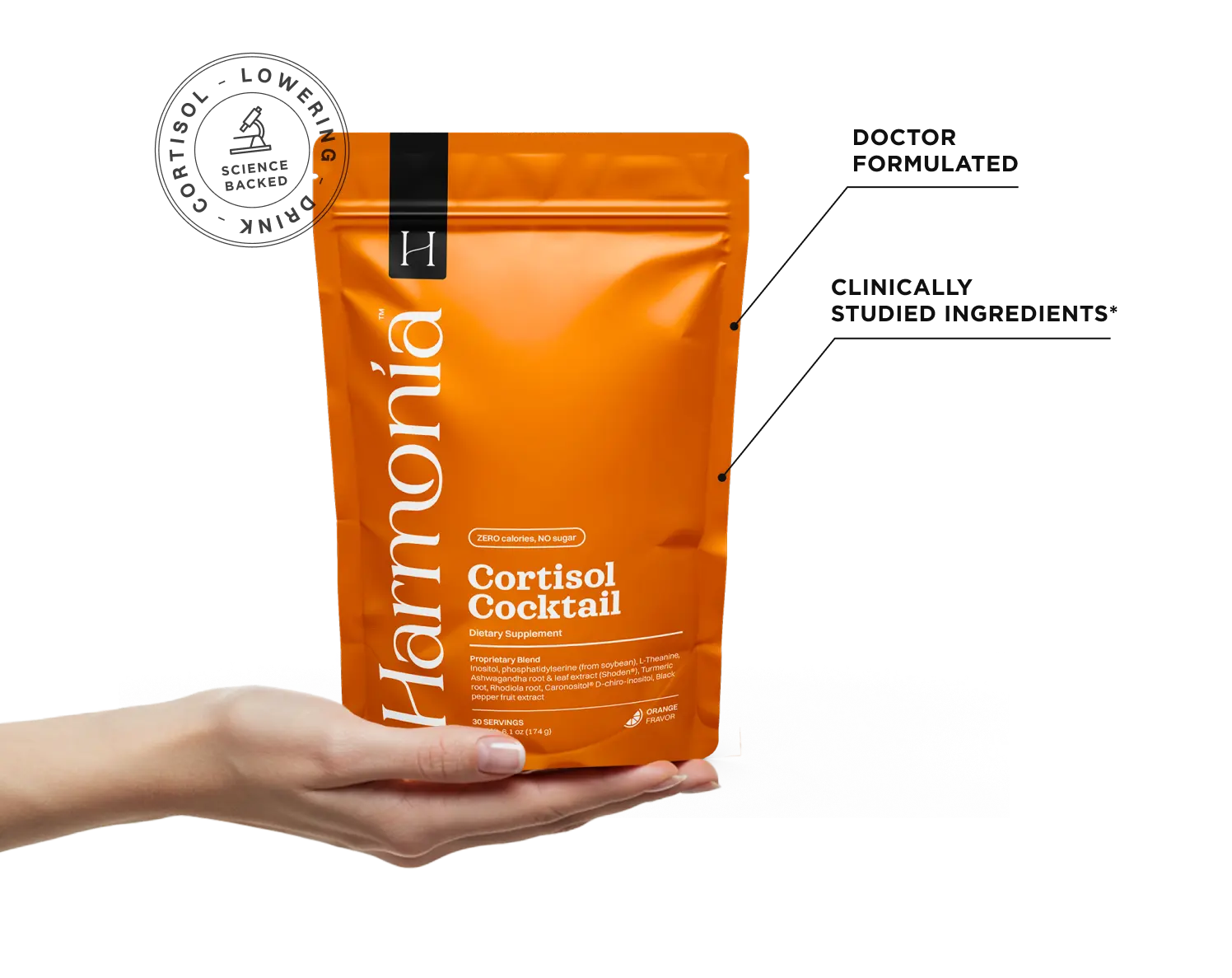
The Harmonia Cortisol Cocktail uses KSM-66, a standardized ashwagandha root extract with human research behind stress and cortisol support.
The Harmonia Cortisol Cocktail ingredient list pairs KSM-66 with ingredients that address other ways ongoing stress can show up. L-theanine supports calm focus, Rhodiola rosea is studied for stress-related fatigue, magnesium supports normal nervous-system function, and myo- and D-chiro-inositol are involved in insulin and hormone signaling.
That broader approach may be particularly relevant when weight concerns overlap with stress, cravings, poor sleep, fatigue, or hormone-related changes.
The weight findings discussed in this article come from studies of ashwagandha extracts themselves, not the finished Harmonia formula.
The bottom line
Ashwagandha does not appear to cause weight gain as a typical effect.
Some human studies have actually reported lower body weight, BMI, or food-craving scores, particularly in people experiencing chronic stress or overweight.
That does not make ashwagandha a weight-loss supplement. Its strongest evidence is still for stress and cortisol support, and any effect on weight is likely to be indirect and highly individual.
If your weight changes after starting ashwagandha, consider what else may have changed at the same time, including appetite, sleep, stress, activity, medications, hormones, and fluid balance.
For women whose weight concerns tend to overlap with stress, cravings, or poor sleep, the Harmonia Cortisol Cocktail combines KSM-66 ashwagandha with L-theanine, Rhodiola rosea, magnesium, and inositols to support several parts of the stress response.
If stress, cravings, or poor sleep are part of your weight picture, you can take the Harmonia quiz to see whether the Cortisol Cocktail fits what you're experiencing.
Frequently asked questions
Can ashwagandha cause weight gain?
Current human trials do not show unwanted weight gain as a consistent effect. Some randomized studies have instead reported lower body weight or fewer food cravings.
Is weight gain a side effect of ashwagandha?
No. Weight gain is not listed among the better-established short-term side effects in current NCCIH guidance. More commonly reported effects include drowsiness and digestive symptoms.
Does ashwagandha increase weight in women?
Human research has not found a clear female-specific tendency to gain weight from ashwagandha. Weight changes in women can also be influenced by hormones, thyroid function, medications, sleep, stress, and activity.
Does ashwagandha increase appetite?
Increased appetite is not a consistent finding in controlled trials. Some studies have actually reported lower food-craving or hunger-related scores.
Can ashwagandha help you gain weight intentionally?
Ashwagandha is not an established weight-gain supplement. Resistance-training studies suggest it may support muscle size and strength when paired with structured exercise, which could affect scale weight.
Does ashwagandha cause water retention?
Water retention has not been established as a typical effect. Rapid unexplained weight gain or swelling should be assessed separately because fluid retention has many possible causes.
Does ashwagandha speed up metabolism?
Human research has not shown a reliable increase in metabolic rate in healthy adults. Studies have found changes in thyroid hormones in some populations, but that does not prove faster calorie burning.
How long does ashwagandha take to work for weight loss?
There is no established weight-loss timeline. Direct weight studies lasted between 8 and 24 weeks, but those study periods do not guarantee that someone taking ashwagandha will lose weight within the same timeframe.
References
- Choudhary, D., Bhattacharyya, S., & Joshi, K. (2017). Body weight management in adults under chronic stress through treatment with ashwagandha root extract: A double-blind, randomized, placebo-controlled trial. Journal of Evidence-Based Complementary & Alternative Medicine, 22(1), 96-106. Link
- Pakhale, K., Pakhale, R., Srivathsan, M., Langade, J., & Langade, D. (2025). Efficacy and safety of Ashwagandha (Withania somnifera) root extract on stress and weight management in adults: A prospective, randomized, double-blind, placebo-controlled study. Journal of Medicine and Life, 18(12), 1140-1154. Link
- O'Connor, J., Lindsay, K., Baker, C., Kirby, J., Hutchins, A., & Harris, M. (2022). The impact of ashwagandha on stress, sleep quality, and food cravings in college students: Quantitative analysis of a double-blind randomized control trial. Journal of Medicinal Food, 25(12), 1086-1094. Link
- Arumugam, V., Vijayakumar, V., Balakrishnan, A., et al. (2024). Effects of Ashwagandha (Withania somnifera) on stress and anxiety: A systematic review and meta-analysis. Explore, 20(6), 103062. Link
- Wankhede, S., Langade, D., Joshi, K., Sinha, S. R., & Bhattacharyya, S. (2015). Examining the effect of Withania somnifera supplementation on muscle strength and recovery: A randomized controlled trial. Journal of the International Society of Sports Nutrition, 12, 43. Link
- Verma, N., Gupta, S. K., Patil, S., Tiwari, S., & Mishra, A. K. (2024). Effects of Ashwagandha (Withania somnifera) standardized root extract on physical endurance and VO2max in healthy adults performing resistance training: An eight-week, prospective, randomized, double-blind, placebo-controlled study. F1000Research, 12, 335. Link
- Sharma, A. K., Basu, I., & Singh, S. (2018). Efficacy and safety of ashwagandha root extract in subclinical hypothyroid patients: A double-blind, randomized placebo-controlled trial. Journal of Alternative and Complementary Medicine, 24(3), 243-248. Link
- National Center for Complementary and Integrative Health. Ashwagandha: Usefulness and safety. Link
- National Institutes of Health, Office of Dietary Supplements. Ashwagandha: Is it helpful for stress, anxiety, or sleep? Health Professional Fact Sheet. Link