_1_11zon.jpg)

Your period was due days ago. Nothing has changed in your diet. Your weight is stable. A pregnancy test came back negative. But your cycle still has not arrived.
If the past few weeks have felt relentless, stress could be the reason. Your body has a built-in system that pauses your cycle when it senses you are under too much pressure. It sounds strange, but it is completely normal biology.
This article explains exactly how stress delays a period, how long that delay can realistically last, what happens when stress stops your period entirely, and what you can do when this starts happening regularly.
How Stress Disrupts Your Menstrual Cycle
Think of your body as running two separate systems at once. One handles stress and survival. The other handles your menstrual cycle. When life gets overwhelming, your body makes a choice. It prioritizes the survival system and puts the cycle system on the back burner.
When your brain senses ongoing stress, it tells your body to release cortisol, your main stress hormone. Cortisol is not a bad thing in small doses. It helps you stay alert, manage blood sugar, and handle pressure. The problem starts when cortisol stays high for too long.
High cortisol sends a signal to the part of your brain that controls your menstrual cycle. That signal essentially says: "Now is not a good time." Your brain stops sending the messages needed to trigger ovulation, so ovulation gets delayed or skipped.
And here is the key thing to understand: your period only comes after ovulation. So no ovulation means no period. It is that direct.
A review on cortisol and female fertility confirmed that high cortisol can shut down the reproductive process at multiple points. When your body is under sustained stress, it deprioritizes reproduction to focus on survival.
Can Stress Delay Your Period? What the Research Says
Yes, it can. And the evidence is consistent. A study on perceived stress and menstrual cycles found that the more stressed women felt, the more likely their period was to go off schedule. This was not a small effect. It was a clear, measurable pattern.
Your period typically arrives about 12 to 16 days after ovulation. So when stress delays ovulation by a week, your period gets pushed back by about a week too. It is a direct chain reaction.
Stress and missed periods are not just in your head. There is a real biological reason. Your hormones are responding to what your body is experiencing.
How Late Can Stress Make Your Period?
The delay varies a lot depending on how severe and how long-lasting the stress is. Here is a simple breakdown:
How long can stress delay your period? As long as the stress is still there. When the pressure lifts, most women find their cycle returns within one to two months. Chronic stress that never really resolves is what causes the longer delays.
Can Stress Stop Your Period Entirely?
Yes. If ovulation gets skipped for an entire cycle, there is no period. This is more common than most people realize, and it is not dangerous on its own in the short term. But if it keeps happening cycle after cycle, it is worth looking into.
According to the Office on Women's Health, stress is a recognized cause of missing periods, alongside major weight changes, thyroid issues, and hormonal conditions like PCOS. If you have ruled out pregnancy and your period has been gone for more than six weeks, it is a good idea to speak with a doctor.
Why Managing Cortisol Is the Key to Getting Your Cycle Back
If stress keeps pushing your period off track, the answer is not to just track your cycle and hope for the best. Fix the root cause, not the symptom. Your body responds to the hormonal environment that has built up over weeks, not just one bad day.
Lower your cortisol consistently, and your body can get back to its natural rhythm on its own. It does not need much. It just needs the pressure to let up long enough for your cycle to restart.
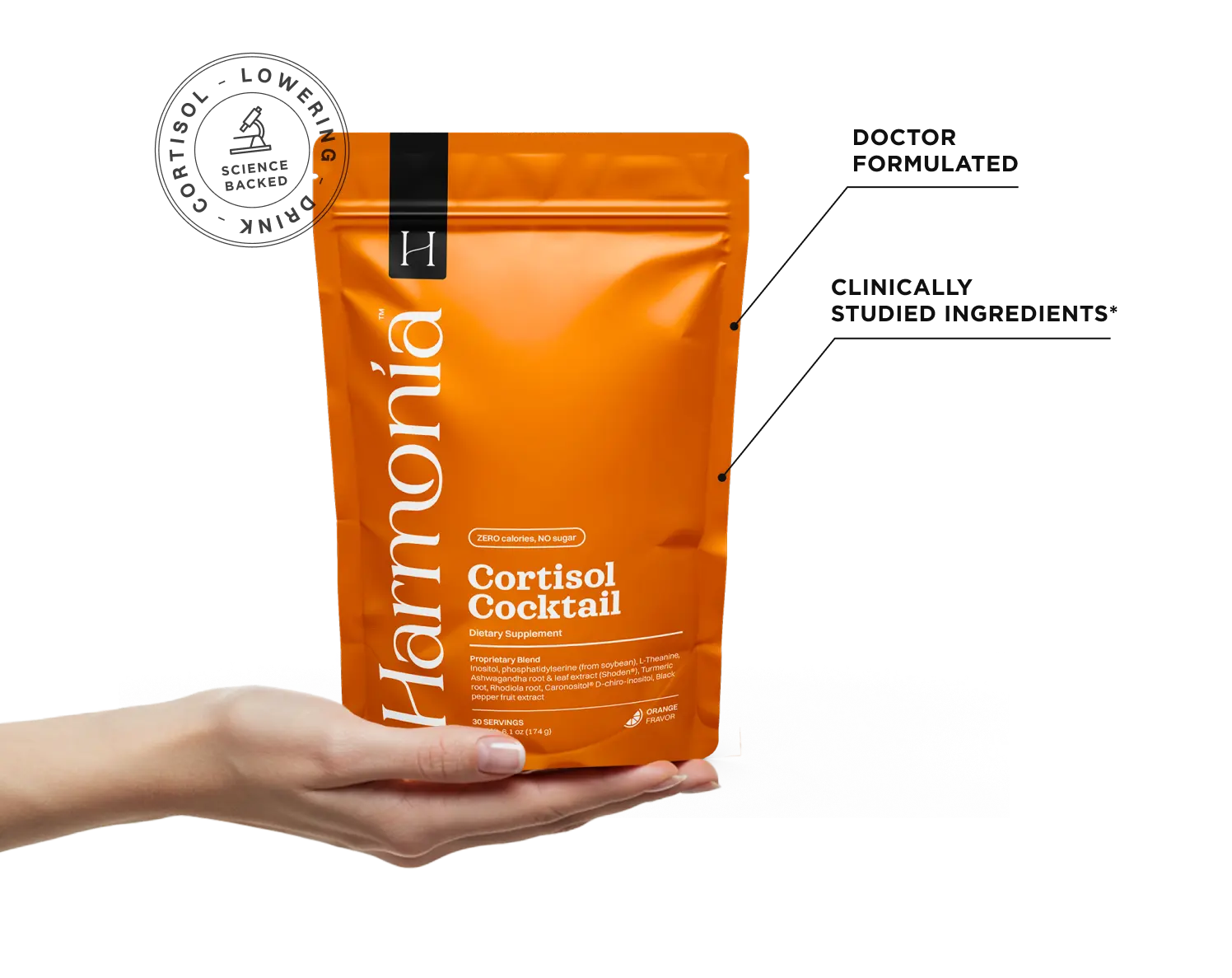
Harmonia is a daily drink that combines adaptogens like Ashwagandha and Rhodiola with Magnesium and Myo-Inositol to help your body handle stress without derailing your cycle. If you want to understand how stress connects to the bigger picture of your hormones, the guide on hormonal imbalance symptoms in females is a helpful place to start.
What Types of Stress Are Most Likely to Affect Your Period?
Not every form of stress affects your cycle in the same way. How much impact stress has depends on the type, duration, and your health. Here are the most common culprits.
Emotional and Psychological Stress
This is the most common one. Work pressure, relationship problems, grief, anxiety, and constant worry all raise cortisol gradually over days and weeks. Because this kind of stress does not just go away overnight, it keeps your body's stress response running in the background.
This is why emotional stress is the most common reason otherwise healthy women experience a late or missed period.
Physical Stress
Your body does not distinguish between emotional stress and physical stress. Illness, surgery, intense training, and very low-calorie diets all raise cortisol in the same way.
Women who dramatically increase their workout volume or cut calories aggressively often notice their period disappears within a month or two. The body is redirecting its resources away from reproduction.
Sleep Deprivation
Poor sleep is its own form of stress on the body. Even a few nights of bad sleep raises cortisol, disrupts other hormones, and makes everything harder to regulate.
If you are already emotionally stressed and also not sleeping well, the two compound each other significantly. Together, they are much more disruptive to your cycle than either one alone.
Signs Your Late Period Is Stress-Related
Not every delayed cycle comes back to cortisol. But if several of these apply to you at the same time, stress is probably behind it:
- You have ruled out pregnancy with a home test
- The delay started during or right after a particularly hard stretch of weeks
- You are also experiencing fatigue, mood swings, brain fog, or strong sugar cravings
- Your cycle was regular before the stressful period began
- Your period came back once things calmed down
- This has happened more than once during high-stress periods
When several of these match your situation, it points clearly toward cortisol as the driver. The most effective response is to address that, not just wait and see.
How Daily Cortisol Support Helps Break the Pattern
If a late period keeps happening every time life gets hard, daily cortisol support works better than waiting. Trying to react after a delay has already started means you are always playing catch-up.
Your body builds up its hormonal environment over weeks, not days. That is why what you do consistently matters more than any single good or bad day.
Harmonia Cortisol Cocktail is a daily drink that works best when it becomes part of your regular routine, the same way sleep and food do. It is not something you reach for after a missed period. It is what helps prevent the pattern from starting in the first place.
Women dealing with PCOS alongside stress will find additional context in the guide on cortisol and PCOS weight management, which explains how layered hormonal issues make cycle recovery more complex.
What to Do When Stress Is Disrupting Your Cycle
The goal is not just to manage stress at the moment. Target the cortisol itself. These are the habits that make the most difference for cycle regularity.
%20(1)_1_11zon.jpg)
Keep a Consistent Sleep Schedule
Waking up at the same time every day, even on weekends, is one of the most effective things you can do for your cortisol rhythm. Your body uses your wake time to set the hormonal tone for the whole day.
Late nights, irregular sleep times, and scrolling your phone before bed all keep cortisol higher in the evening when it should be coming down. Aim for 7 to 9 hours in a cool, dark room on a regular schedule.
Eat Regularly and Stabilize Your Blood Sugar
Skipping meals and eating too little both raise cortisol. Your body treats going without food as a stressor. Rather than cutting back, focus on eating steady meals with protein, healthy fats, and fiber throughout the day.
A review on stress reduction and cortisol found that consistent daily stress practices combined with lifestyle support, including nutrition, produced measurable reductions in cortisol over time. What you eat supports what else you are doing.
Match Your Exercise to Your Stress Level
Hard daily training adds more cortisol to an already stressed body. During high-stress periods, switching to walking, yoga, swimming, or lighter strength work lets you stay active without making things worse.
Pulling back on intensity during a stressful stretch is not falling behind. It is a smart hormonal move.

Use Adaptogens Daily and Stick With Them
Adaptogenic herbs like ashwagandha and rhodiola help your body handle stress without completely shutting down its stress response. They work with your system, not against it.
A meta-analysis of ashwagandha clinical trials found that people who took ashwagandha consistently had measurably lower cortisol than those who did not. The catch: both ashwagandha and rhodiola take four to eight weeks of daily use before you notice a real difference. Consistency is the whole game.
For women navigating cycle disruption alongside perimenopause, the guide on cortisol and menopause explains how those two things compound each other and why daily support matters even more during that window.
When to See a Doctor About a Late Period
A single late period during a stressful stretch is usually nothing to worry about. But reach out to a doctor if:
- Your period is more than six weeks late and pregnancy has been ruled out
- You have missed three or more periods in a row
- The delay comes with hair loss, major weight changes, or extreme fatigue
- The pattern keeps repeating with no clear reason
- You are trying to get pregnant and your cycle has been irregular for more than three months
A doctor can run a simple blood test to check your hormone levels and figure out whether your cycle will come back on its own or needs help. Catching it early gives you more options.
Building a Daily Routine That Supports Cycle Regularity
.jpeg)
If stress is messing with your cycle regularly, the best thing you can do is stop waiting for it to fix itself and start building a routine that actively supports your hormones every day.
When your cortisol stays lower day after day, your body has the breathing room it needs to get your cycle back on track.
Harmonia Cortisol Cocktail was formulated for exactly the gap between lifestyle effort and actual results. It brings together Ashwagandha, Rhodiola Rosea, L-Theanine, Magnesium, and Myo-Inositol in a single daily drink, targeting the cortisol, sleep, and hormonal stability that makes everything else you are doing more likely to work.
Conclusion
So can stress delay your period? Yes. When cortisol stays elevated, your body puts ovulation on hold. No ovulation means no period, or at least a later one.
A short stressful week might push your period back by a few days. Months of chronic stress can stop it entirely. The good news is that once you consistently lower your cortisol, your cycle tends to come back.
Sleep, regular meals, the right amount of exercise, and daily cortisol support all work together to give your body the stability it needs to regulate itself. None of it is complicated, but all of it requires consistency.
If your cycle keeps going off track, take the quiz to see how Harmonia can help bring your cortisol back to a level where your body feels safe enough to regulate itself again.
Frequently Asked Questions
Can stress affect your period even when you feel okay?
Yes. Cortisol can stay elevated due to poor sleep, overtraining, or sustained low-grade pressure even when you do not feel obviously stressed. Your body's stress response can be running in the background well before you feel it emotionally.
Can stress cause your period to be late by just a few days?
Yes. A brief or mild stressor usually produces a delay of three to seven days. Once the stress passes and ovulation resumes, your next cycle typically returns to its normal timing.
Does stress delay ovulation or the period itself?
Stress delays ovulation. Because your period comes 12 to 16 days after ovulation, pushing ovulation back automatically pushes your period back by the same amount. Your period is a result of ovulation, not a separate event.
Can your period stop from stress permanently?
Permanent loss of your period from stress alone is uncommon. But if periods stay absent for three or more months, it is worth getting checked out. Prolonged disruption can affect bone density and fertility over time.
How do I know if my missed period is from stress or something else?
Start by ruling out pregnancy. Then think about whether the timing lines up with a stressful period in your life. If your cycle comes back within six weeks, monitor the next one or two. If things do not normalize, see a doctor to check for thyroid issues, PCOS, or other hormonal conditions.
References
- Whirledge, S., & Cidlowski, J. A. (2010). Glucocorticoids, stress, and fertility. Minerva endocrinologica, 35(3), 227-239. Link
- Nagma, H., et al. (2015). To evaluate the effect of perceived stress on menstrual function. Journal of Clinical and Diagnostic Research, 9(3), QC01-QC3. Link
- Chandrasekhar, K., et al. (2012). A prospective, randomized double-blind, placebo-controlled study of safety and efficacy of ashwagandha root extract. Indian Journal of Psychological Medicine, 34(3), 255-262. Link
- U.S. National Library of Medicine. (2023). Cortisol test. Link. Link
- Office on Women's Health. (2021). Period problems. womenshealth.gov. Link
- Nyklicek, I., et al. (2013). Mindfulness-based stress reduction and physiological activity during acute stress. Health Psychology, 32(10), 1110-1113. Link